
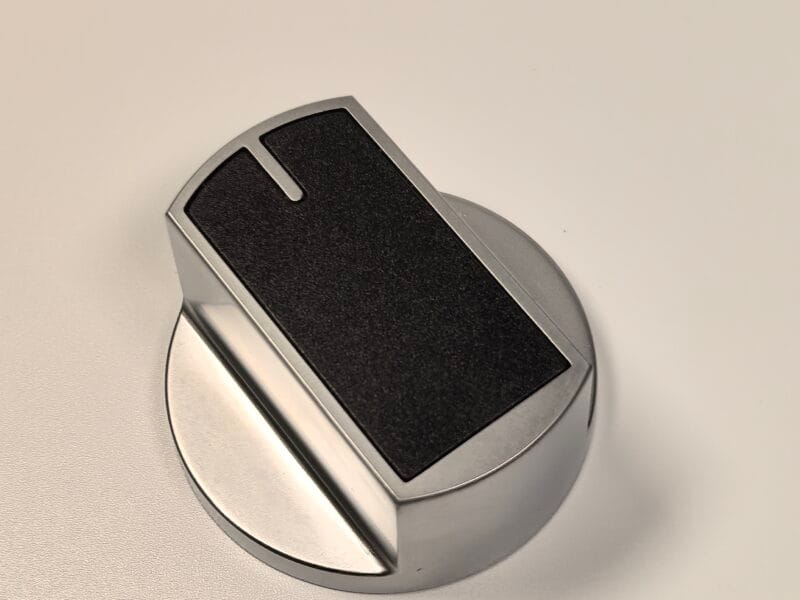
Metal vs plastic appliance knobs is a choice about the whole part: what the user touches, what carries the turning load, how the shape is made and what the assembled control must withstand. A metallic face does not tell you whether the body underneath is metal or plastic.
Choose the construction against the appliance’s operating conditions and design brief. Then compare actual material grades and finished samples. Neither material family is automatically cooler to touch, more durable or less expensive in every design.
Compare three constructions before comparing materials
For a useful comparison, separate metal-bodied knobs, plastic-bodied knobs and composite knobs with a decorative cap or shell. Describe the body and the visible surface independently.
A metal-bodied knob might be cast or machined, while a molded plastic body can incorporate a separate insert or decorative part. These alternatives can share a similar outside shape yet have different internal structures. The first question is therefore what the proposed part contains, rather than what its photograph resembles.
Use a section drawing or an approved disassembled sample to identify:
- The body that supports the shaft connection.
- The surfaces the user grips while turning.
- Any separate cap, insert or decorative shell.
- The joints between those components.
Keep this construction description beside each candidate during review. Otherwise, one supplier may be quoting a solid metal body while another is proposing a plastic body with a metal face, and the apparent material comparison will be misleading.
Appearance and touch are different requirements
A design brief can ask for a metallic appearance, a particular weight in the hand, a smooth face or a textured gripping area. Those are separate requirements. Record which ones matter before treating metal as the only route to the desired result.
For example, a project may want a metal front face while keeping another construction for the shaft hub. Another may require a continuous metal surface across the sidewall and front face. Each brief leads to a different comparison.
Review the knob on the intended panel, including adjacent controls. A finish that looks right as an isolated sample may appear different beside the appliance’s trim. The feel also depends on shape, surface condition and the mechanism behind the knob. A heavier sample should not be accepted as proof of better control or longer service life.
If weight is part of the brief, specify a target for the complete assembly and confirm it on samples. Do not compare a finished metal assembly with an unfinished plastic body and attribute the entire difference to material alone.
Geometry changes the manufacturing discussion
Metal and plastic routes provide different ways to make a shape. NADCA describes die casting as injecting molten metal into a reusable steel die. Machining removes material, whereas injection molding forms a plastic part in a mold. These process differences affect how a proposed design should be reviewed.
For a cast or molded proposal, ask the supplier to identify the parting line and the surfaces needed to release the part. For a machined proposal, ask how tools will reach the internal and external features. A process label by itself does not resolve those questions.
A plastic body may bring ribs, a hub and an exterior wall into one molded component. Whether that layout is practical depends on the material and tooling design. A metal version of the same visible outline may need a different section or a different sequence of operations. Avoid insisting that two candidates have identical internal geometry merely to make the comparison appear fair.
Keep the external requirements fixed where necessary, then let each route propose a manufacturable internal design. Compare the resulting parts against the same functional requirements.
Heat performance needs assembled-part evidence
Do not use the oven’s displayed cooking temperature as the knob’s material specification. Record the conditions at the control location and the relevant operating situations. The appliance engineer should define how those conditions will be measured and assessed.
For plastic, the exact resin grade matters. Celanese’s PBT information distinguishes different formulations and reinforcement options. A property quoted for a material family or a selected grade cannot establish the performance of every PBT knob.
For metal, the alloy name alone does not establish the temperature of the user’s contact surface. The assembled design and operating conditions still need review. A metal cap over a plastic body also needs assessment as a combined construction.
Compare candidates using a common application requirement. Keep the grade identity, part configuration, exposure conditions and acceptance decision with the evaluation record. That makes the comparison more useful than an unsupported claim that one material is always heat-resistant.
Cleaning and repeated use belong in the comparison
The appliance may expose the knob to handling, cooking residues and approved cleaning products. Define the intended cleaning instructions and the surfaces that must retain their appearance and function.
Assess the complete surface system. A painted metal knob, an uncoated molded plastic knob and a metal-capped plastic knob should not be treated as three bare materials. Coatings, markings and joints can each introduce a separate question.
For each candidate, ask what evidence is available for the proposed cleaner, contact conditions and expected handling. Decide which changes would be unacceptable: loss of legibility, a changed surface feel, visible damage or a problem with the assembly. The project must set the method and limits; a generic material comparison cannot supply them.
Include the interface in repeated-use evaluation without turning this into another shaft specification exercise. The question here is whether the proposed body and construction remain suitable in use. Detailed mating dimensions should stay in the controlled component drawing.
Compare metal vs plastic appliance knobs with a decision matrix
Use the same questions for every candidate:
| Decision area | What to compare | What does not establish suitability |
|---|---|---|
| Construction | Body, contact surfaces, inserts and joints | A front-view photograph |
| Appearance | Complete sample beside the appliance panel | A material name or screen image |
| Operating feel | Grip task with the intended control mechanism | Weight alone |
| Environment | Grade and assembly evidence under defined exposure | A broad heat or chemical-resistance claim |
| Manufacture | Proposed geometry, operations and approval stages | A process label without a part review |
| Commercial route | Complete quoted configuration and agreed assumptions | An isolated material or piece-price comparison |
Treat an unknown as a request for evidence. Do not automatically give it an average score. If one construction has not been evaluated under the required conditions, record that gap before making the selection.
Compare complete supply routes, not material prices
The purchased item includes more than raw material. Depending on the proposal, it may involve tooling, machining, finishing, marking and assembly. Ask each supplier to explain the scope of its route and the configuration covered by the quotation.
An existing plastic design and a newly tooled metal design do not represent a controlled comparison of material alone. Similarly, a machined prototype and a production molded part may answer different questions. Keep development costs, production assumptions and approval work visible when comparing them.
There is no universal order quantity at which metal or plastic becomes the cheaper option. Request project-specific proposals for the demand scenarios you actually expect. Use the same appearance standard, supplied assembly and inspection requirements across those proposals.
Build a shortlist with a clear reason for each choice
Retain candidates because they satisfy defined requirements or offer a credible way to close an evidence gap. A useful shortlist might include a metal-bodied design and a plastic-bodied alternative, each with a documented construction and sample plan. It does not need one of every material.
For available starting points, compare the zinc alloy knob range and plastic appliance knob range. Treat those as model references rather than proof of suitability for a new appliance.
The outcome should be a chosen construction, a defined sample configuration and a short list of unresolved requirements. Detailed grade, finish and assembly approval can then proceed against that decision.
Discuss the construction for your appliance
For a drawing-based project, see custom appliance knob manufacturing. Send your construction reference and application details so the metal, plastic or composite route can be reviewed against the part you need.